Share
Like
Comment
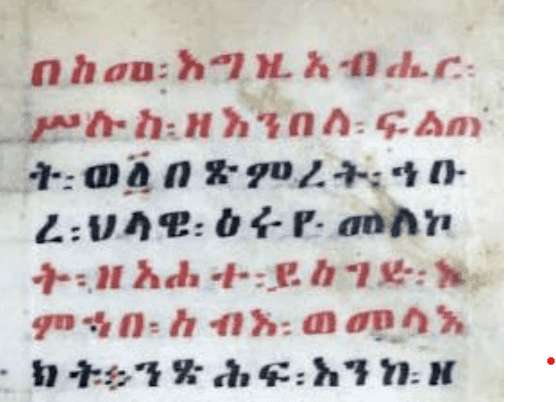
An in-depth exploration of how the ancient Ge'ez language was intentionally preserved by the Ethiopian Orthodox Church to serve as the living, acoustic engine of its divine liturgy for over a millennium.
by Unknown —7 min read
Step into the circular architecture of an Ethiopian or Eritrean Orthodox Tewahedo Church during the pre-dawn hours, and you will hear a sound that defies the relentless march of time. As the heavy, intoxicating aroma of frankincense fills the air and the rhythmic, metallic clash of the tsenatsel (sistrum) echoes off the walls, a choir of priests and cantors chant in a linguistic medium that has not been spoken in the mundane streets for over a millennium.
This is Ge'ez (ግዕዝ).
Western linguistic frameworks often mistakenly classify Ge'ez as a "dead" language, relegating it to the same historical dustbin as Latin, Sumerian, or Ancient Greek. However, to apply this secular terminology to Ge'ez is a fundamental misunderstanding of its utility and its legacy. Ge'ez did not die; it was intentionally elevated. As the ancient Aksumite Empire waned in the first millennium and its daily vernacular fractured into the modern languages of Amharic, Tigrinya, and Tigre, the Church made a highly deliberate, calculated decision. They locked Ge'ez inside the sanctuary.
By removing the language from the marketplace, they stripped it of everyday, mundane corruption. Ge'ez became the exclusive, immutable vessel of the divine. It became the only phonetic system deemed pure enough to carry the weight of the Qidasse (the Divine Liturgy) and the intricate theological treatises of the faith. Today, we will bypass the generic history of its alphabet and dive deeply into the highly specialized mechanics of how this language operates as the acoustic and intellectual engine of a living faith.
The survival of Ge'ez is not an accident of history; it is the result of an institutionalized, intellectually punishing educational system designed to produce the ultimate linguistic guardians known as the Debteras. A Debtera is a highly educated, traditionally unordained cleric who serves as the cantor, poet, theologian, and scholar of the church. Their mastery of Ge'ez is not superficial or merely conversational; it is absolute, rooted in absolute grammatical precision.
To achieve this rank, a student must progress through a grueling, decades-long curriculum divided into four specialized traditional schools, often situated in remote monasteries.
First is the Nibab Bet (School of Reading). Here, young students memorize the syllabary and learn to read Ge'ez texts with flawless pronunciation, often before they fully comprehend the vocabulary. They are building the phonetic muscle memory required for the liturgy. They learn the exact cadence of the Psalms of David, swaying back and forth to internalize the rhythm of the syllables.
Second comes the Zema Bet (School of Music), where the focus shifts entirely to the acoustic delivery of the language. Third is the Qene Bet (School of Poetry), which is the true intellectual crucible of the language. Finally, the elite scholars reach the Metsihaf Bet (School of Books), focusing on deep textual exegesis, commentary, and translation of ancient manuscripts.
This systematic, compartmentalized approach to language preservation was essential. Because the language was no longer evolving naturally in a secular society, the Church had to build an artificial, highly disciplined academic environment to keep the syntax, grammar, and vocabulary exact. The Debteras are essentially human repositories of this ancient tongue, committing entire libraries of text to memory and ensuring that the pronunciation remains unchanged from generation to generation.
You cannot truly understand the Ge'ez language without understanding how it is physically vocalized. In the sixth century, an Aksumite scholar and priest named St. Yared completely restructured the acoustic delivery of Ge'ez. He created the Zema, an indigenous tradition of sacred chant, accompanied by a complex musical notation system known as Meleket.
St. Yared did not simply write songs; he engineered a sonic framework that is inextricably linked to the phonetics of the Ge'ez alphabet. Every single character in the Ge'ez script (the Fidel) is an abugida, meaning it represents a consonant paired with an inherent vowel sound. Yared's notation dictates the exact microtonal pitch, duration, and vocal modulation for each specific syllable. The Meleket symbols are written in faint red ink directly above the black text of the manuscripts, serving as a highly efficient metadata layer that guides the cantor's voice.
Yared established three distinct modes of chanting, each mapped perfectly to the emotional and theological cadence of the Church calendar.
1. The Ge'ez Mode: Not to be confused with the name of the language itself, this is the foundational, authoritative, and straightforward chant used on ordinary days. It is robust, declarative, and deeply grounding.
2. The Ezl Mode: This is a slower, deeply melancholic, and heavy tone. The phonetic delivery of the Ge'ez language in the Ezl mode stretches the vowels, creating a mournful resonance that perfectly mirrors the theological weight of Lent, Holy Week, and periods of strict fasting.
3. The Araray Mode: This is a complex, joyful, and highly melodic mode used for major feast days like Fasika (Easter) and Timkat (Epiphany). The vocal gymnastics required in Araray push the Ge'ez syllables to their limits, soaring and cascading in celebration. The language here becomes completely musical.
By fusing the grammatical structure of Ge'ez with this immutable musical framework, St. Yared ensured that the language could not easily drift or degrade over centuries. The melody acts as a strict safeguard. If a word is mispronounced or a syllable altered, the centuries-old melody instantly collapses, alerting the entire congregation to the error.
While the Zema preserves the acoustic integrity of Ge'ez, the Qene preserves its intellectual elasticity. Qene is an advanced form of extemporaneous, improvised poetry composed strictly in Ge'ez. It is deeply embedded in the liturgy, but it is also the ultimate proving ground for a scholar's mastery of the language's incredibly complex grammatical rules.
The defining characteristic of a masterful Qene is a rhetorical and structural device known as Sem-enna-werq, which translates to "Wax and Gold." The concept is derived from the lost-wax method of casting gold sculptures. In a Qene poem, the "Wax" is the literal, surface-level meaning of the verse. It is usually a benign, straightforward statement about nature, biblical history, or daily life.
But hidden within the specific syntactic choices, double entendres, and verb conjugations of the Ge'ez is the "Gold", which is a deeper, profound, often subversive, or highly complex theological revelation.
To construct a Sem-enna-werq poem in real-time requires a staggering cognitive load. The poet must deeply understand the morphosyntactic alignment of Ge'ez verbs, which can hold entirely different meanings depending on subtle shifts in conjugation, prefixes, suffixes, and placement within the sentence structure. A single, perfectly placed Ge'ez verb serves as the hinge point between the Wax and the Gold.
During major church festivals, the most learned Debteras will stand before the congregation and compose these dual-layered poems on the spot. This is where Ge'ez proves it is not just a static language of rote recitation, but a dynamic, incredibly rigorous system capable of supporting extreme intellectual complexity. The Church uses Qene to prevent the language from becoming stagnant. It forces scholars to actively manipulate the syntax, ensuring the deepest mechanics of the grammar remain functional and thoroughly understood, rather than just memorized.
The tactile relationship the Church has with the Ge'ez language is equally as important as the vocal one. While modern printing presses exist and are widely used for daily prayer books, the most sacred Ge'ez texts, especially the massive, ornate Gospel books used on the altar, are still completely handcrafted in the traditional manner.
Monks and scribes prepare branna (parchment made from cured goat or sheep skin) through a laborious, weeks-long curing and stretching process. They mix their own inks from scratch, utilizing soot, crushed gallnuts, and local plant extracts to create pigments that will survive for centuries.
Writing Ge'ez on vellum is not viewed as a mere administrative task; it is an act of deep theological devotion. The scribes write in the characteristic Fidel script, carefully maintaining the strict proportions of the letters. The resulting illuminated manuscripts, with their striking red and black lettering, geometric borders, and vibrant iconography, are not just books containing a language. They are venerated liturgical objects. The physical creation of these books ensures that the visual representation of Ge'ez remains intimately tied to the labor and prayer of the monastic community.
In examining the Ge'ez language strictly through the lens of the Ethiopian and Eritrean Orthodox Tewahedo Churches, we see a masterstroke of cultural preservation. By intentionally stripping the language of its secular utility, the Church shielded it from the natural linguistic decay, slang, and morphological shifts that erase most ancient tongues.
Through the grueling, multi-tiered educational system of the Debteras, the fault-tolerant musical structure of St. Yared’s Zema, the rigorous, real-time syntactic processing required by Qene poetry, and the enduring craft of vellum manuscript creation, Ge'ez has been perfectly insulated.
It remains an unbroken linguistic chain connecting the modern era directly to late antiquity. When the priests raise their voices in the sanctuary today, enveloped in incense and the sound of the sistrum, they are not merely reciting an ancient text. They are participating in a living, breathing tradition that has operated flawlessly, exactly as intended, for well over a thousand years.
 Shimelis G
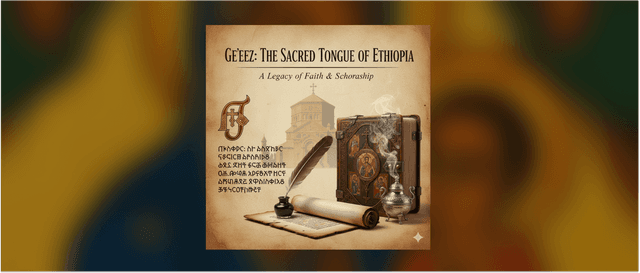
Ge'ez is an ancient Semitic language that serves as the liturgical language of the Ethiopian Orthodox Tewahedo Church. Though no longer spoken in daily life, it remains vital for religious texts, prayers, and church services, functioning similarly to Latin in Catholicism. The language has its own unique script and has profoundly shaped Ethiopian Christian identity and scholarship for over 1,500 years.
 Unknown
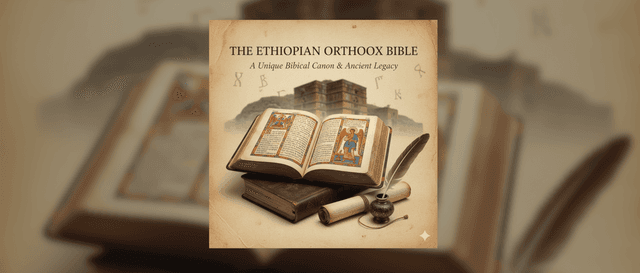
The Ethiopian Orthodox Church has the largest biblical canon with 81 books, including texts like the Book of Enoch and the Book of Jubilees, preserved in Ge'ez since the 4th century. These books, considered authoritative, shape its theology and liturgy. The canon reflects a unique Christian tradition, with ancient manuscripts still central to worship and identity.