Sacrament of Marriage
Sacrament of marriage is one of accepted marriage in Ethiopian orthodox church which had great value
by Unknown —3 min read
The Sacrament of Holy Matrimony in the Ethiopian Orthodox Tewahedo Church (EOTC)
The Sacrament of Holy Matrimony, known as Temeche or Tewahdo (meaning "union" or "being made one"), is one of the seven holy sacraments of the Ethiopian Orthodox Tewahedo Church (EOTC). It is not merely a legal contract but a sacred, lifelong covenant where a man and woman are spiritually joined into one flesh by God, dedicated to mutual help, companionship, and the godly raising of children.
Purpose and Essence of the Sacrament
The EOTC views marriage as a continuation of the divine will established in the Garden of Eden and sanctified by Christ at the wedding in Cana of Galilee. The core purposes are threefold:
- Spiritual Unity (Tewahdo): The primary purpose is the spiritual perfection of the couple. The union is an icon of the mystical union between Christ and the Church.
- Companionship and Mutual Aid: Marriage provides a life partner to share joys and sorrows, bearing one another's burdens as they journey toward the Kingdom of Heaven.
- Procreation and Godly Upbringing: The secondary purpose is the raising of children within a holy environment, training them in the Orthodox faith and virtuous living.
The Marriage Ceremony (Silat)
The celebration of Holy Matrimony in the EOTC is a majestic and lengthy liturgical service performed by a priest, typically within the church building (though not always on the Altar/Tabot).
Key Elements of the Rite:
- Exchanging of Rings (Qulqul): The priest blesses and places the rings on the right hands of the bride and groom, symbolizing their perpetual union and eternal bond.
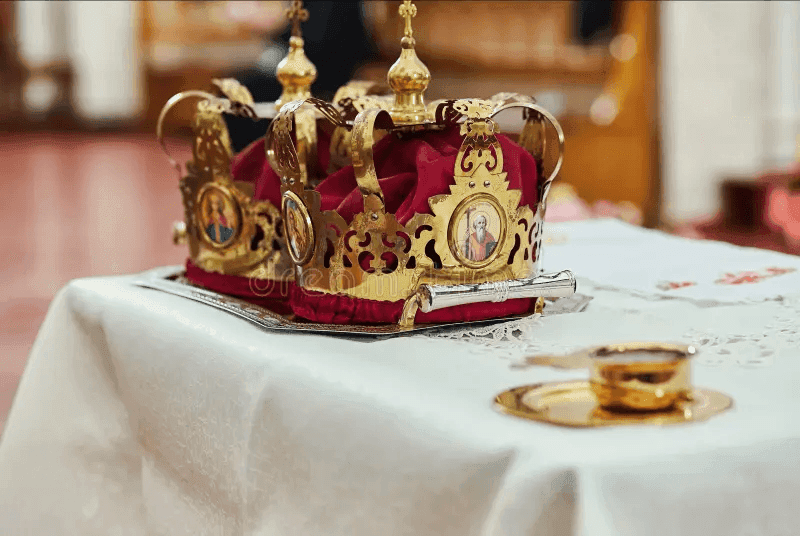
- The Blessing and Crowning (Ekkil-Bet): This is the central, ancient act of the ceremony. The priest places crowns (aklil) upon the heads of the couple. The crowns symbolize the royalty of the couple as the 'king and queen' of their own small kingdom (the home) and also the crown of martyrdom, signifying their commitment to endure suffering and hardship together.
- The Common Cup: The couple shares a cup of wine, signifying that they will share everything in life—both bitterness and sweetness—as one.
- Reading of the Epistles and Gospel: Biblical passages are read, emphasizing the sanctity of marriage and the duties of husband and wife, often referencing Ephesians 5, where the husband is called to love his wife as Christ loved the Church.
- The Final Blessing: The service concludes with a prayer for the couple to be fruitful, remain faithful, and live together in peace and righteousness.
The Indissolubility of the Bond
The EOTC places a strong emphasis on the permanence of the marital bond. Following the words of Christ, the Church maintains that what God has joined together, no person should separate.
- Divorce: Divorce is extremely rare and discouraged. It is only permitted under very strict, exceptional circumstances, primarily due to adultery or extreme, debilitating circumstances that make the continuation of the shared life impossible.
- Remarriage: Remarriage in the Church is also restrictive. A person whose spouse dies may remarry, but the Church encourages the preservation of the sacred bond even beyond death. Remarriage after divorce is granted only as an act of pastoral economy (oikonomia), intended to prevent greater sin, and often involves a penitential aspect.
The Sacrament of Holy Matrimony is thus seen as a solemn, profound commitment—a pilgrimage undertaken together by two souls seeking salvation and reflecting the unbreakable love of God.
The Latest
You May Also Like

In Christ, my God
In Christ, my God In morning's light and evening’s grace, Where shadows fall, and stars embrace, My heart in faith lifts to the skies, For Christ, my God, whose touch never dies.

Oh Mary, dear Mary
Oh Mary, dear Mary, How great must your faith be? To submit to the will of God, At the annunciation That you shall give birth To the almighty
College and Spirituality
“Let us consider one another to provoke unto love and to good works, not forsaking the assembling of ourselves together…” Heb. 10:24-25